Climate Change and Liberal Priorities by Gideon Calder & Catriona McKinnon
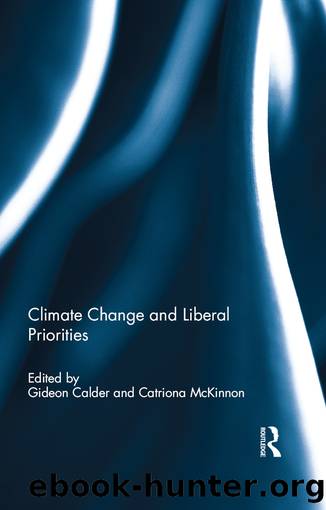
Author:Gideon Calder & Catriona McKinnon [Calder, Gideon & McKinnon, Catriona]
Language: eng
Format: epub
Tags: Political Science, Political Ideologies, Democracy, Public Policy, Environmental Policy
ISBN: 9780415846622
Google: E-cdlgEACAAJ
Barnesnoble:
Goodreads: 17269593
Publisher: Routledge
Published: 2013-01-15T07:23:58+00:00
A ârightâ to pollute?
Having dismissed the moral âexcusesâ, above, now consider another way in which members of the global elite might protest against the coercive enforcement of environmental duties, by any collective authority. This is by appeal to alleged individual rights, which such enforcement would violate.23
The possibility of rights protecting individuals against application of the harm principle has long been acknowledged by its proponents. As already stressed, Mill does not regard harm to others as a sufficient condition for legitimate interference. Rather, he argues (Mill 1991, pp. 83â84):
As soon as any part of a personâs conduct affects prejudicially the interests of others, society has jurisdiction over it, and the question of whether the general welfare will or will not be promoted by interfering with it, becomes open to discussion.
Corresponding to this âgeneral welfareâ is a system of social rights, and it is only when actions harming others fall outside their sphere that the state can interfere with individual freedom.
This paper does not offer a purely utilitarian argument and, like many liberals, I do not uphold Millâs (1991, p. 15) eschewal of natural or human rights. Thus, rather than remaining within the framework of social rights grounded in overall welfare, the question here is more general: what rights might individuals in this generationâs global elite have such that, while it is unfortunate that what they are doing results in harm to others, they have a perfect right to do it, the others have no right that they not do it, and they cannot legitimately be coerced into not doing it?
Clearly, the appeal cannot be to a right to unrestricted negative liberty, as this would simply beg the question: it is precisely the legitimacy of limiting such liberty to avoid harm which is under discussion. Such a right would undermine the whole idea of the harm principle. Moreover, it would not be able to carry the argument. There are negative freedoms at stake on both sides of the debate. The liberty of a resident of a Mexico City shanty town is restricted if he attempts to take his asthmatic child into a private health spa but is forcibly prevented, just as much as is that of a UK driver prevented from putting fuel in his car unless he pays tax on it.24
Nor will self-ownership, alone, do the necessary work, for it is not merely our own bodies and our own labour that we use to pollute. Rather, what are required for members of this generation to have an all-trumping right to continue to act in the ways which in combination produce harmful climate change are not only strong self-ownership rights but also some very stringent rights of ownership of natural resources. These would have to be strong enough to justify not only using up finite resources, but also the devastating impact this use has on potentially unlimited resources such as water and air.
Full discussion of this point would require a detailed analysis of (particularly libertarian) attempts to derive property rights. However, it
Download
This site does not store any files on its server. We only index and link to content provided by other sites. Please contact the content providers to delete copyright contents if any and email us, we'll remove relevant links or contents immediately.
| Anthropology | Archaeology |
| Philosophy | Politics & Government |
| Social Sciences | Sociology |
| Women's Studies |
The Secret History by Donna Tartt(19092)
The Social Justice Warrior Handbook by Lisa De Pasquale(12191)
Thirteen Reasons Why by Jay Asher(8912)
This Is How You Lose Her by Junot Diaz(6889)
Weapons of Math Destruction by Cathy O'Neil(6281)
Zero to One by Peter Thiel(5802)
Beartown by Fredrik Backman(5759)
The Myth of the Strong Leader by Archie Brown(5509)
The Fire Next Time by James Baldwin(5448)
How Democracies Die by Steven Levitsky & Daniel Ziblatt(5219)
Promise Me, Dad by Joe Biden(5154)
Stone's Rules by Roger Stone(5088)
A Higher Loyalty: Truth, Lies, and Leadership by James Comey(4964)
100 Deadly Skills by Clint Emerson(4927)
Rise and Kill First by Ronen Bergman(4790)
Secrecy World by Jake Bernstein(4753)
The David Icke Guide to the Global Conspiracy (and how to end it) by David Icke(4720)
The Farm by Tom Rob Smith(4514)
The Doomsday Machine by Daniel Ellsberg(4490)
